Hello there,
Life's been busy and a lot more fun. If you are following me on Facebook and don't see many updates from me, you know it already ;). I have not been able to write regularly on this blog. I hope to make it better this year. I continue to write for a couple of magazines and public forums. I got a couple of requests to write for a few corporate blogs for money. I declined politely as I am working on a bunch of cool things myself.
In November 2011, I was invited by Aditi Technologies, Bangalore for a Corporate Talk. I spoke about "Myths of Test Estimation". It appears they liked my talk at the time. At least that is what they told me :).
In December 2012, they got in touch with me for a Guest blog post for their corporate blog. It was a good feeling to be asked to write for a corporate blog. I took on the challenge.
I have meddled with Test Coverage Triage for a long time now. I tried several times to write this piece. Somehow, it never worked out. I said to myself, "I try one last time. If I don't get it, I quit thinking about this topic." Note that when a writer says she'll quit, it only means that the idea is half-baked and will come out when its ready :). There is no writer's block, mind you.
I thank Jari Laakso and Mohit Verma for their valuable suggestions. If this article looks good in its present form, I owe it to both of them. Thanks Jari and Mohit. You were amazing with your reviews!
You can find the Guest Blog HERE.
Happy Reading.
Regards,
Parimala Hariprasad
12 February, 2013

16 December, 2012
How to Think & How to Test
Every time I picked up Edward De Bono’s book, I fell asleep.
My friends kept telling me how their life has changed after reading De Bono.
For me, it was a painful journey across the ocean. After failing to read 4
books of De Bono in the past, I picked up ‘Teach Your Child How To Think’ with
a ‘Never Say Never’ attitude recently.
What an experience it was! I loved this book, so much that I
re-read it to understand some thinking concepts better than when I read it
first time. You can’t read some books in life until you are ready for it. ‘Linchpin’
for e.g. was a very interesting book way back in 2010. When I shared this book
with a couple of my senior colleagues, this book successfully put them to
sleep. So is the story with ‘Are your lights on?’ I thought there was nothing
great in this book excluding the tunnel problem. When I re-read it a year ago,
I experienced the real ‘Are your lights on?’ moment.
 |
| How to Think and How to Test |
James Bach and I discussed studying and books in detail
during his stay in Bangalore. He said that if we replace the word ‘Think’ with ‘Test’,
everything that De Bono says applies to Testing. It’s so true.
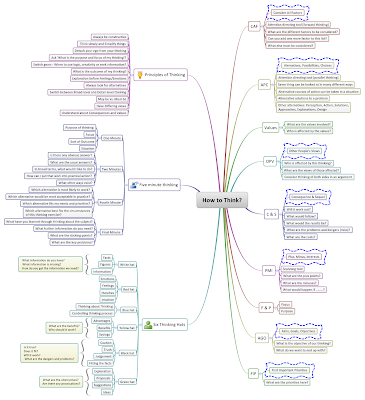
I created a mind map (above) based on the book ‘Teach Your Child How To Think’ as a placeholder post for my reference. If you find it useful, you must read the book. You can even download this blogpost HERE.
I created a mind map (above) based on the book ‘Teach Your Child How To Think’ as a placeholder post for my reference. If you find it useful, you must read the book. You can even download this blogpost HERE.
Regards,
Parimala Hariprasad
20 November, 2012
Test Ed - Rise of thinking Indian Tester
 |
| Test Ed - a Tester's Conference |
Testing Education
I have interviewed a bunch of fresh grads in recent months. When I ask few of them, "You seem to know Java, what if we need you to code in C sharp", they effortlessly answer that it's organization's responsibility to train them. That is how some of us think despite being in the industry for many years. If an individual's education was employer's responsibility, we wouldn't have witnessed the rise of great men and women in any field. It's an individual's responsibility to take care of his/her education.
No knowledge is wasteful ever. Knowledge gained can be used at anytime. In fact, that is the biggest investment which is least talked about in the World of Money. Yet, we weight knowledge against money and put knowledge down on the weighing scale.
Test Ed
Test Ed is a Tester's Conference organized by the testers, for the testers. We need more and more testers to rise up to the challenge of creating great testing talent pool in India. To accomplish that, Moolya has initiated this conference as a first small step.
Test Ed - Low Cost conference
We are aware that some of us can't afford to attend a 8k or a 10k conference for 1-2 days. We are aware of the fact that not everyone in the organization can be sent to the conference. We are also aware that you need to see value for your money if you happen to visit this conference. How do we solve so many problems at one shot? In Pradeep's own words, "Our goal is that a student and wanna-be tester should be able to afford this. So we came up with 500 rupees per person + 12.36% service tax". Its probably the cost of evening snacks if you walk up to any mall in Bangalore. You decide whether you want to be a part of it.
Test Ed - High Value conference
An opportunity to meet James Bach, Pradeep Soundararajan and Rahul Verma
An opportunity to meet some of the brightest minds of testing industry
An opportunity to network with fellow testers
And an opportunity to educate yourself on testing - straight from some of the greatest minds of the industry
And more than all of these, you are going to meet passionate testers who are as passionate as you, facing some problems you may have solved, have solutions for some of your challenges and be of value to your passion called Testing.
If you want to attend, click HERE to register. For more details on the conference, Visit Test Ed website.
See you @ Test Ed.
Regards,
Parimala Hariprasad
16 October, 2012
Free E-book :: Web Accessibility Testing Heuristics
Hello Dear Readers,

My first FREE E-book on "Web Accessibility Testing Heuristics" is available for download HERE.Santhosh graciously hosted this document on his server. Other sources to download from are below:
Scribd
Slideshare
My first FREE E-book on "Web Accessibility Testing Heuristics" is available for download HERE.Santhosh graciously hosted this document on his server. Other sources to download from are below:
Scribd
Slideshare
This E-book has a list of heuristics to look for while testing for accessibility of websites. As the name suggests, it is a heuristic list and nowhere close to a robust list. Feel free to take a look and post your thoughts!
Acknowledgement
I am thankful to Santhosh Tuppad for putting
the early thoughts of Accessibility into my mind and my colleagues at Moolya who
spoke about Accessibility in one form or another at different points in time. I
am also thankful to Mohit Verma
and Santhosh Tuppad for helping with reviews.
Happy Testing!
Regards,
Parimala Hariprasad
24 September, 2012
Interview with Santhosh Tuppad on Usability
Do you like great interiors and ambience at hotels or restaurants you visit? One could correlate food to functional and interiors and ambience adding up to usability which adds value to the dining experience.
Here is an interview with Santhosh Tuppad who emphasizes
on usability being crucial testing for any software that is designed and
developed for people around the world or people of specific location or any
living being or could be anything. Usability is a deeper study and testers who
say, “Oh, usability is to see if application is user friendly”, they are mostly faking it.
The hard truth on the contrary is, it's not easy and has never been easy. I got Santhosh to answer a few questions. Take a look.
Why do you call usability as a crucial ingredient for software?
a. Win more
customers
b. Give the best
to your customers
c. Win over your
competitors
d. Entice your
competitors customers as your customers
e. Give better
user experience for your customers
f.
Want to make more business and increase your
revenues
g. Make people
spread a word about your software
h. Ultimately, help
do GREAT BUSINESS!
My management is not serious about it or developers just reject the usability bugs I report?
This is a classical problem that most of the testers find. Here are some tips that might make them serious about it. Even if you could change ones thinking, then you have made a better impact).
- Build good rapport with your manager and make him / her understand about usability and its importance.
- Conduct a meeting with your team members and speak to them about usability and how to report them (Bug Advocacy).
- Even if developers reject your bugs, there should be a genuine reason and not just like that. Keep reporting even if they reject. All the testers in your team should report huge number of usability bugs and then I bet they will not reject them or higher management looks into them because so many bugs are being rejected. At least, you will not be pointed when customer reports the same usability bug which you wanted to report but were biased that the developer may reject it and hence did not report it.
What books do you read / how do you practice usability?
- Psychology reference book
- http://useit.com/ and http://boxesandarrows.com/ are good ones to refer (Be careful, you need not agree with everything these people are telling. There need to be your own thinking, that’s when you could make things better rather than following someone else’s ideas blindly. Here, you will see how I opposed the idea of Jakob Nielsen – http://useit.com/ however; I refer to it for some cool study).
- I design websites (Well, buggy ones)
- I interact with UI / UX designers
- I attend conferences on UI / UX
- I keep myself updated with new technologies which could add value to software when implemented or when enhanced
- I co-related usability with the things in day to day life. I do exercises with the things around me about usability.
What are the important skills you think you posess for getting better at Usability testing
Analyzing “What could be good” for end-users. Most of the times, I have succeeded when I analysed things over time. However, there is bad side to it when you just start getting biased by your thoughts of usability rather than seeing it from customers’ point of view. I have seen testers saying, “You got to put yourself in customers shoes” and then test for usability. Well, its easy to say; but too challenging to do it. Your customers might range from -- millions, billions, trillions of end-users with different brains, different thinking abilities and different ways of using software. Now, you see, “Wow, this is really challenging”. If you still do not feel it, then either you do not want to accept it or you do not understand it. Continue to do your functional testing. Most of the organizations are happy with it.
I have cultivated a practice of arguing with my own thoughts about usability. I have seen at times, when my colleagues just agreed whatever I said but, I go back and think on those lines. Finally, I get better approach than what I really said. So, that’s the thinking power. Do not stop just because people stopped arguing with you. You argue with your own thoughts or you say to yourself, there is something better I can do rather than sticking to my old ideas.
Do you conduct workshops or talks or would be interested in guiding aspiring testers?
With respect to talks, I am interested to explore opportunities in formats like half-day seminars or 2 hour talks on usability.
With respect to mentoring or guiding someone, I feel I am running out of my bandwidth as there are many people who are approaching me for security testing. However, I could support you people over e-mails but, do not expect quick replies. I would at least take 1 week however; you might receive responses at the earliest in few hours or minutes as well.
Related articles on Usability
About Santhosh Tuppad
Santhosh Tuppad is the Co-founder & Senior Tester of Moolya Software Testing Private Limited (www.moolya.com). He also recently won the uTest Top Tester of the Year 2010 apart from winning several testing competitions from uTest and Zappers. Santhosh specializes in the exploratory testing approach and his core interests are security, usability and accessibility amidst other quality criteria. Santhosh loves writing and he has a blog at: http://tuppad.com/blog/. He has also authored several articles and crash courses. He attends conferences and confers with testers he meets. Santhosh is known for testing skills and if you are passionate in testing, feel free to contact him at: Twitter: santhoshst | Skype: santhosh.s.tuppad | Santhosh.Tuppad@gmail.com20 September, 2012
Why testing isn't good? - Inspection Vs. Prevention
Ether was happy with the way his life was going. He had been getting a pay hike every six months and a promotion every two years. Not to mention the heap of awards showered on him on a quarterly basis.
And then came the storm
Suddenly, Org wanted several "Ethers" in Testerland. They wanted to create more Ethers, train them and do what it takes to replicate many such Ethers. After all, one Ether could not succeed in blessing all releases 24/7. He was human and he needed to avoid burning out. Organization thought the same. Thankfully.
Org lined up all its concerns in testing with Test-eagle, the highest authority in Testing. Test-eagle had set up the first team in Org which had now grown to about 10,000 testers in Testerland alone. He was a key guy responsible for all the innovative stuff that had happened in Testerland so far. It was only obvious he had to get involved in this mission.
Test-eagle met up with top executives in Testersland and heard them out. He decided that a few decisions had to be made. His questions were pretty simple:
- Why are more testers not transforming like Ethers?
- What is stopping Org from building more Ethers?
Test-eagle lined up all the managers in Testerland, Devland, Techland and others and passed a mandate on the following:
- A new role 'Lead tester' was created who report to Quackle, who headed QCOE - Quality Center of Excellence
- For every two testers, there will be a lead tester
- Lead tester will supervise tester's work on a day to day basis
- Lead tester will come up with metrics based on tester's work
- Lead tester will present the findings to the leadership once every Quarter
Lead testers were the new Quality InspectorsTest-eagle was to review the results after 1 month. Interestingly, Test-eagle didn't have an inkling of what was happening with testers in Testerland although he passed the "Inspection Bill" and expected it to rock as always.
One month later...........
Test-eagle was welcomed with a pile of results and findings from lead testers who were proud of their findings. Some key observations were listed as below:
- Ether had left Org for greener pastures
- "Ethers in the making" had left Org for greener pastures
- Testers in close proximity to Ether in talent and knowledge also left ...... for greener pastures of course!
- Testers who were doing well on an average stopped doing so. Motivation had dropped
- Testers who were doing what they were told to do no longer did it; instead stopped doing anything at all. Productivity was as low as nothing
- Testers who didn't do anything meaningful continued to do the same
- Customer started complaining that even basic requirements were not functioning properly
Quality lay breathless at Org's Doorstep
What happened?
- Lead testers brutally pin pointed how testers can be better in what they do.
- Lead testers wanted the testers to follow 50% scripted approach and 50% exploratory approach in addition to 20% of time/effort contribution to Automation
- Lead testers wanted to review every bug before it was reported in the bug tracking system
- Lead testers questioned the severity of bugs
- Lead testers rejected several valid bugs because they didn't think that those were bugs
- Lead testers questioned testers if they missed any bugs
- Lead testers questioned testers if they thought testers tested very little on a particular day
Lead testers forced the testers to TRY HARDER and DO BETTER which testers were already doing. Something more had to be done. No one knew what that "something more" was.
What went wrong?
Test-eagle ignored the following which was a sub-set of problems that existed:
- Test environments were never stable. Release management team hardly took onus
- Test environments if available needed lot of troubleshooting from testers before it worked
- Checking in code changes into environments took days at a stretch
- Code drops to testing teams never happened on time. There was always a 2 week delay
- If code drops happened on time, then a very small code mass came for testing. For e.g, if there were say 10 features, only 1 feature would have been available in testing
- Code drops coming towards release deadlines contained massive number of features
- Availability of data for testing was always a problem. Data team always forced testers to compromise testing with workarounds. Data team provided invalid or nonsensical data at times. A laptop for example would cost only 2 Baht
- Infrastructure in testing environments were never provided on time. If the production environment needed 3 load balancers, testers would be advised to test without the load balancer and certify that the code works fine and doesn't break anything new. Whether the code worked with 3 load balancers in production was a question not to be asked
- And a lot more..........
What's wrong with the inspection approach?
Inspection chokes! How will you feel if your mom or dad just kept staring at you without saying a thing to you while you do your household chores. Same thing had happened to Testerland testers.
There was a need for a CHANGE IN THE SYSTEM in totality. What Test-eagle did was to transform just the "Testing System" converting people in other systems to Supervisors who oversaw testing work and mocked at it. Test-eagle put complete responsibility of quality with testing team and let others go scot free.
Test-eagle failed to understand that Quality is everyone's job, but management's responsibility.Test-eagle was highly de-motivated. What on earth failed his plan on which he had invested his blood and sweat on. He had to calm down. He had to come down to tester's level. He had to prevent some or all of the tester's problems listed above to be able to improve the quality of testers. He had to fix a few problems that were built into the system even before blaming the 'Testing system'. And he did. As a first step, he figured he didn't need Lead testers. Not that he fired them. He still kept them, but after stripping off their Inspector roles. He made them part of the system.
Inspection Vs. Prevention mind-set
Test-eagle moved away from an Inspection mind-set to a Prevention mind-set. He thought that if he fixed a lot more problems in many other non-testing teams, testing teams could do better. Testers could do better. Ethers could come back to Org without a second thought. He looked at some of the key problems that Org was facing for a long time. He identified top five problems to begin with. He summoned the respective stream leaders and discussed problems in detail. A brainstorming session followed. Few action items were noted. And the group was off to execute.
 |
| Courtesy: www.docstoc.com |
Test-eagle took each stream to task and fixed the problems one after the other. Slowly, testing team was empowered. Empowered to TEST BETTER!
*This post is inspired by John Guaspari's book 'I Know It When I See It'.
Regards,
Parimala Hariprasad
Subscribe to:
Posts (Atom)